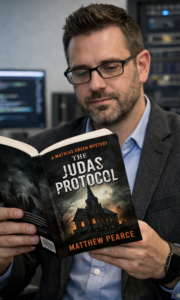
IT consulting is not just about fixing systems, recommending tools, or guiding a migration plan. At its best, it is about learning how to see what other people miss, staying calm when the facts are incomplete, and helping organizations make wise decisions when the stakes are high. That is exactly why Mathias Green: The Judas Protocol makes such an interesting read for this audience. On the novel’s official book page, the story opens with the death of theology professor Silas Hawthorne in a locked archive vault and a suppressed manuscript tied to earlier deaths, placing the reader in a world where anomalies are rarely random and patterns matter more than appearances. That premise alone speaks to the daily reality of IT advisors, who often step into environments where the visible problem is only a surface symptom of something far deeper.
The Best IT Consultants Learn to Read Patterns Before Everyone Else
According to Wikipedia’s overview of IT consulting, the field is centered on advising organizations on how to use technology to meet business goals. In practice, that means an IT consultant has to be part strategist, part investigator, and part translator. That role is becoming even more important in a market where Gartner’s 2026 IT spending forecast says worldwide IT spending is expected to reach $6.15 trillion in 2026, while McKinsey’s technology trends outlook continues to highlight AI, cybersecurity, cloud, and digital trust as defining forces. In other words, the pressure on consultants is increasing, not shrinking. The people who stand out are the ones who can look at scattered clues, separate noise from signal, and identify the pattern before the organization pays the price for missing it.
That is one of the clearest lessons in The Judas Protocol. Mathias Green does not simply react to a dramatic event. He studies the inconsistencies around it. He notices what does not fit. He follows the thread behind the official explanation. IT consultants live in that same mental space. A failed implementation is rarely just a failed implementation. A security incident is rarely just a user mistake. A bloated cloud bill is rarely just a budgeting issue. Most serious business technology problems are the result of hidden dependencies, ignored warnings, poor assumptions, or cultural blind spots that stacked up over time. Reading a suspense novel built around concealed motives, buried records, and a dangerous pattern of events reinforces a skill that good consultants need every day: disciplined attention. It reminds them that the first explanation is often the weakest one.
Trust Is Valuable, but Verification Is What Protects the Client
One reason this story fits the IT consulting mindset so well is that it deals with institutions, records, language, and hidden meaning. Those are not abstract themes for consultants. They are daily working realities. In business technology, trust is important, but untested trust can become a liability. Documentation can be incomplete. Vendors can oversell. Teams can assume controls are in place when they are not. Leadership can hear “we are compliant” and believe the work is finished. That is why strong consultants are known for careful validation. They confirm what is actually happening in the environment instead of relying on what was said in a meeting.
That mindset also aligns with where the industry is headed. NIST Cybersecurity Framework 2.0 continues to emphasize governance and risk management as core parts of cybersecurity, not optional extras, while CISA’s guidance on product security bad practices pushes organizations and software makers to avoid preventable weaknesses that create downstream risk. For IT consultants, the message is simple: credibility is built when you verify architecture, permissions, dependencies, software origins, and operational reality. The Judas Protocol works on that same principle. The danger in the book is not just the manuscript itself. The danger is what people assumed, ignored, concealed, or misunderstood about it. That is a lesson every consultant can carry straight into security reviews, platform selection, AI governance, and vendor due diligence.
Technology Problems Are Never Only Technical
Another reason this novel has value for IT professionals is that it highlights how systems are shaped by the people inside them. Consultants know this better than most. The best architecture in the world can still fail if the organization lacks alignment, courage, ownership, or communication. The sharpest security policy can still collapse when users do not understand it, leaders do not reinforce it, or teams quietly work around it. In the current market, that human factor is only becoming more important. Harvard Business Review’s look at AI and consulting firms argues that AI is reshaping how consulting work gets done, and CIO coverage on building IT leaders for an AI-driven future reflects how leadership expectations are shifting alongside that change. The consultant who thrives now is not just technically informed. That person understands people under pressure.
Mathias Green’s world is full of that tension. The mystery does not move forward because the facts are conveniently available. It moves because people guard access, interpret events through their own bias, protect institutions, and respond emotionally to truth. That should sound familiar to anyone who has ever walked into a digital transformation effort. IT consultants are often hired because the company says it has a software problem, but many times the deeper problem is that the organization has a trust problem, a clarity problem, or a leadership problem. A novel like this sharpens awareness of that reality. It reminds readers that intelligence is not only about technical brilliance. It is also about reading the room, recognizing incentives, and understanding why smart people can still make dangerous decisions.
Pressure Reveals the Difference Between a Vendor and a Trusted Advisor
A lot of professionals can recommend tools. Far fewer can stay steady when things get messy. That is where great consultants separate themselves from the crowd. Businesses do not only need implementation support. They need judgment. They need someone who can absorb complexity without spreading panic. They need someone who can step into competing agendas, conflicting data, and partial visibility, then create a path forward that is practical and credible. That kind of presence is part of why the consulting profession remains attractive. The U.S. Bureau of Labor Statistics outlook for computer systems analysts projects 9% employment growth from 2024 to 2034, which is much faster than average, reflecting ongoing demand for professionals who can connect systems thinking to business results.
The Judas Protocol reinforces the value of that steady presence. Mathias Green is not useful because he makes noise. He is useful because he keeps thinking. He does not let mystery, tension, or institutional pressure force him into shallow conclusions. That is exactly how trusted consultants earn long-term respect. They do not just arrive with a framework and disappear with a slide deck. They stay engaged long enough to understand the real pattern, communicate it clearly, and help leaders act on it. In a time when AI can automate pieces of analysis and documentation, that quality becomes even more valuable. Clients will increasingly remember the advisor who brought calm, discernment, and integrity when the situation felt uncertain.
Why This Kind of Story Matters for IT Consultants
There is also something worthwhile about the genre itself. Strong fiction can sharpen professional instincts because it trains the mind to watch for relationships between evidence, motive, systems, and consequence. That is one reason christian suspense novels can resonate with thoughtful professionals who spend their days making sense of complex environments. When the suspense is built on secrecy, institutional power, moral tension, and hidden protocol, the reading experience becomes more than entertainment. It becomes practice in observation. For IT consultants, that has real value. The job is full of half-told stories, conflicting narratives, and environments where what matters most is often buried below the first layer. A book that rewards patience, discernment, and pattern recognition can actually mirror the mental discipline the profession requires.
There is a second benefit too. Reading outside technical material helps consultants stay human. It broadens instinct. It strengthens communication. It reminds them that every system exists inside a moral and emotional world, not just a technical one. That matters because clients do not hire consultants only for expertise. They hire them for clarity, confidence, judgment, and trust. Those qualities are not built by dashboards alone. They are shaped by how well a person understands risk, consequence, narrative, and human behavior. A suspense novel centered on coded language, institutional secrecy, and the danger of misread meaning has more in common with consulting than many people might expect.
Conclusion
What IT Consultants Can Learn from Mathias Green: The Judas Protocol comes down to this: the strongest consultants are not merely technical operators. They are careful readers of systems, people, signals, and consequences. They know how to notice what does not fit, verify what others assume, and stay composed when the situation becomes complicated. That is the same kind of intelligence that drives a compelling suspense story, and it is one reason this novel feels unexpectedly relevant to the consulting profession. In a business climate shaped by AI acceleration, cybersecurity pressure, cloud complexity, and rising expectations for leadership, IT consultants need more than certifications and checklists. They need discernment. The Judas Protocol offers that kind of mental exercise in story form, making it a smart and memorable read for professionals who make their living finding truth inside complexity.