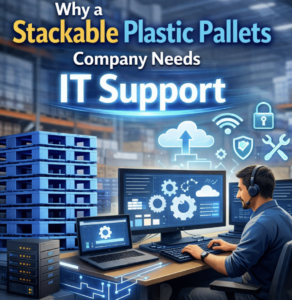
A stackable pallets company does far more than move wood, plastic, or composite products from one place to another. It manages inventory, coordinates deliveries, communicates with warehouses and distributors, handles quotes and invoices, tracks customer orders, and keeps operations moving across phones, computers, scanners, printers, email systems, and cloud platforms. In a business like this, technology is not sitting on the sidelines. It is right in the middle of production, fulfillment, customer service, scheduling, and growth.
That is exactly why IT support matters. Technical support is not just about fixing a broken laptop or resetting a password. It is about protecting the systems that keep a company running, reducing costly downtime, keeping data safe, helping employees work faster, and making sure the business can serve customers without interruption. For a stackable pallets company, strong IT support helps connect the office, the warehouse, the sales team, accounting, shipping, and leadership into one dependable operation.
A Stackable Pallets Company Depends on Connected Systems Every Day
A stackable pallets company often has more moving parts than people outside the industry realize. Orders may come in by phone, website form, email, or through repeat B2B relationships. Those orders then connect to inventory counts, production schedules, shipping timelines, delivery coordination, billing, and customer updates. If even one piece of that chain breaks, the entire workflow can slow down.
That makes IT support a business function, not just a technical one. When your order management system goes offline, your barcode scanners stop syncing, your printers fail to print shipping documents, or your team loses access to shared files, the damage is immediate. Sales follow-up gets delayed. Trucks wait. Customers get frustrated. Office staff start doing manual workarounds that eat up time and create errors. A good IT support team keeps those systems stable and makes sure problems are resolved before they start rippling through the whole company.
Downtime Costs More Than Most Companies Expect
In a stackable pallets business, downtime does not only affect computers. It affects fulfillment, inventory visibility, dispatching, invoicing, and communication. A single outage can create confusion between what is available in the yard, what has already been promised to a customer, and what is actually scheduled to leave. When technology is unreliable, the company loses speed, and speed matters in supply chain-driven industries.
IT support helps reduce those disruptions by monitoring systems, managing updates, maintaining backups, replacing aging hardware before failure, and creating clear response plans when something breaks. Microsoft has continued warning businesses about the security and reliability impact of unsupported systems, including the end of Windows 10 support on October 14, 2025, while also offering Extended Security Updates for eligible devices and limited continuing security coverage for Microsoft 365 apps on Windows 10 through October 10, 2028. For a pallets company that may still be using older office or warehouse machines, this kind of transition is exactly where IT support becomes essential instead of optional.
Cybersecurity Is Now a Core Business Need
A stackable pallets company may not think of itself as a technology company, but cybercriminals do not make that distinction. If a company uses email, cloud storage, accounting software, online banking, shipping software, customer databases, or connected devices, it has digital risk. Ransomware, phishing, stolen credentials, fake invoices, and vendor impersonation can all hit a business that depends on fast-moving orders and constant communication.
That is one reason CISA’s small business guidance has emphasized stronger protections for small and medium-sized businesses, including secure-by-design tools, phishing-resistant authentication, and better cyber hygiene. The FTC’s cybersecurity guidance for small businesses also stresses that companies cannot afford to lose time, information, or money to cyberattacks. For a stackable pallets company, that means IT support should include antivirus and endpoint protection, patch management, multifactor authentication, secure backups, employee training, and email security controls.
Without that support, one employee clicking the wrong attachment can lock up critical files, interrupt deliveries, delay billing, and damage customer trust. That is not a small inconvenience. That is a business threat.
Inventory Accuracy and Warehouse Efficiency Depend on Reliable Technology
Many stackable pallets companies operate in environments where inventory movement has to be visible in real time or close to it. The team may be tracking incoming material, repaired pallets, outbound shipments, returned inventory, and custom orders. If the software, tablets, wireless network, or warehouse workstations are inconsistent, the business begins relying on guesswork instead of clean data.
IT support helps keep inventory systems reliable. That includes making sure warehouse Wi-Fi is strong, printers and scanners stay connected, computers communicate with cloud platforms, and users can access the right systems without delay. It also means protecting shared drives, organizing permissions, and building backup procedures so records are not lost during an outage. For a company handling repeat orders and high-volume movement, clean digital systems translate into fewer mistakes, better scheduling, and stronger margins.
Customer Service Improves When Systems Work Smoothly
Customers buying stackable pallets usually want consistency, speed, and confidence. They want accurate counts, dependable delivery windows, responsive communication, and invoices that match what was ordered and delivered. When a company’s systems are outdated or unstable, customer service starts to suffer in subtle but expensive ways.
A missed email because of a mail server issue can cost a reorder. A crashed quoting file can slow a sales response. A billing sync error can create disputes. A dispatch problem can leave a driver waiting on the wrong paperwork. IT support protects the customer experience behind the scenes. It helps keep phones working, email deliverability healthy, shared files available, and software integrations running the way they should.
That support also gives leadership better visibility. When systems are organized correctly, management can review data on order volume, repeat customers, slow-moving inventory, response times, and workflow bottlenecks. Better information leads to better decisions.
Growth Gets Harder Without Scalable IT Infrastructure
A small stackable pallets company can sometimes get by with a patchwork of old devices, shared passwords, and improvised workflows. Growth exposes all of that. The more customers, locations, employees, trucks, and transactions a company handles, the more damaging weak technology becomes.
That is where a structured IT approach matters. The NIST Cybersecurity Framework 2.0 resources for small businesses and NIST’s guidance on building a small business cybersecurity team both point companies toward a more intentional way of managing cyber risk and operational resilience. For a stackable pallets company, that can look like standardizing devices, documenting processes, separating user access by role, creating onboarding and offboarding procedures, and building systems that can support expansion without chaos.
A company planning to add a second yard, more drivers, more warehouse users, or more office staff should not wait until something breaks. IT support helps build the foundation ahead of growth so the business does not trip over its own success.
Data Protection Matters Even in Traditional Industries
Some business owners still assume data risk is mostly an issue for banks, hospitals, or large retailers. That is outdated thinking. A stackable pallets company still holds valuable information, including employee data, payroll information, customer contacts, pricing, vendor details, contracts, payment records, tax documents, shipping addresses, and internal operating files.
IBM’s Cost of a Data Breach Report 2025 says the global average breach cost was $4.44 million, showing how expensive security failures can become. Even when a smaller company is not facing headline-level losses, the effect can still be brutal: downtime, cleanup costs, legal exposure, lost sales, reputational damage, and weeks of distraction. IT support helps reduce that risk by keeping backups tested, applying security updates, limiting unnecessary access, and putting recovery plans in place before a crisis happens.
For a stackable pallets company, protecting data is not about being fancy. It is about being responsible, stable, and ready.
Modern IT Support Creates Operational Confidence
Good IT support is not reactive only. It is proactive. It means someone is watching the systems that power the company, documenting what matters, and helping leadership make smart technology decisions instead of rushed ones. It means the business is not scrambling every time a computer dies, a printer fails, a login breaks, or a suspicious email lands in someone’s inbox.
It also means updates are handled with a plan. Microsoft continues releasing regular Office and security updates, and businesses that fall behind on patching increase both security and compatibility risk. A stackable pallets company with dependable IT support can stay current without creating unnecessary disruption for the team.
Over time, that confidence becomes a competitive advantage. Employees work with less frustration. Customers get faster responses. Orders move with fewer mistakes. Leadership spends less time fighting fires and more time improving the business.
Conclusion
A stackable pallets company needs IT support because technology now touches every important part of the operation. It affects inventory accuracy, customer communication, scheduling, billing, security, reporting, and growth. When those systems are neglected, the company becomes slower, riskier, and harder to scale. When those systems are supported well, the business becomes more dependable, more efficient, and better positioned to serve customers consistently.
This is not just about fixing broken devices. It is about protecting the flow of the business. It is about making sure the warehouse and the office stay connected, the team can do its work without unnecessary delays, and leadership can build on a stable foundation. In today’s environment, a stackable pallets company that invests in IT support is not adding overhead. It is strengthening the operation from the inside out.